Posted on

IDG Contributor Network: Cue the guerrilla marketing — FinancialForce rolls out PSA Communities

One interesting aspect of commentating about a number of vendors in a particular space is that I get to sit in the middle of some competitive mud-slinging. Of course, no one really gets offended by vendor A trying to rain on vendor B’s parade — it’s all part and parcel of the thrust and parry of the industry.

I remember a year ago when ERP vendor NetSuite was holding its annual SuiteWorld event. FinancialForce, a competing ERP vendor, made a big show of choosing just that week to release a new marketing campaign — the “FrankenCloud” campaign was all designed to cast aspersions at the alleged complex and badly integrated solution set of its competitor.

To read this article in full or to leave a comment, please click here

Computerworld Cloud Computing

Link to this post!

All articles

Link to this post!

All articles


RSS-3

Posted on

Pep Boys shows how their marketing cloud scored triple-digit ROI (webinar)

roi.2.shutterstock_295820363

VB WEBINAR:

Imagine every piece of data about a customer, or a potential customer, at your fingertips. Find out why top marketers say that investing in a marketing cloud solution can help you unlock the full promise of data-driven marketing. 

Register here for free.

Rachel Silva, AVP of marketing at the multi-billion dollar auto parts and service chain PepBoys, has been implementing marketing cloud solutions for her company since the day she walked in the door.

And the foundation of any marketing cloud strategy, she says, is finding the right vendor. Even if you think you’ve found your match,  be open to other solutions out there,” she says. “Because at the end of the day, while our relationships are really important to us, we want to make sure we’re using the best solution — and prove out the great solutions we have in place as well.”

Silva and her team have been working with MediaMath since the start. “We’ve always seen positive results,” she says, “and we continue to see an improvement in results year after year.” But, she warns, it’s important to never get too comfortable. “I’m always testing,” she says. “Test, optimize, and then expand.”

MediaMath’s cloud marketing solution, Helix, has become the backbone of Pep Boys’ retargeting and prospecting strategies, helping the  marketing team maximize their spend. Cookie pools are huge, she notes, but you can’t remarket to everybody. How do you best leverage your dollar? “Retailers don’t have CPT budgets,” she adds, “so we need to be as cost effective as possible and we also need to drive sales.”

The marketing cloud is the solution for businesses without the budgets required to carry out a large-scale awareness campaign. It completely replaces that traditional, more scattershot marketing approach with something far more targeted because of the tremendous amount of data available.

To attract new customers and increase online sales, Silva leverages pooled real-time transactional and browsing data from MediaMath to build a picture not only of the existing PepBoy audience, but their potential customers. Lookalike modeling based on cloud data efficiently and cost-effectively targets new prospects.

“We saw our prices decrease and our returns increase,” Silva says. According to Silva, Pep Boys’ cloud-driven prospecting models had a 52 percent lower CPA, and an extraordinary 365 percent increase in ROAS over a two-year period.

“With the expansion of cloud marketing, there’s a lot more data that can be looked at,” she says. “Layer in data whenever and wherever you can, because it’s just going to make results better.”

But how do you determine the best way to get that data? While Silva and Yeoman Technologies CEO Michael Healey will be sharing insights from the front lines, VB Director of Marketing Technology Stewart Roger will be sharing essential take-aways from our recent report: “Marketing Clouds: How the best companies are winning via marketing technology.” Rogers will share how many of the top vendors scored on a number of features and who’s really killing it today.

Don’t miss out!

Register now for free.

After this webinar, you’ll know:

  • What makes up a marketing cloud and why it may be right for your organization
  • The five different types of marketing cloud
  • VentureBeat’s best marketing cloud software bets for SMBs, enterprises, and startups
  • The ROI marketers can expect from their implementation
  • How to encourage and improve user adoption

Speakers:

  • Stewart Rogers, , VentureBeat
  • Michael Healey, CEO, Yeoman Technologies
  • Rachel Silva, Assistant VP, Marketing, Pep Boys

Moderator:

  • Wendy Schuchart, Analyst, VentureBeat


RSS-3

Posted on

Get the most out of your marketing stack by unifying data sources

puzzle pieces

GUEST:

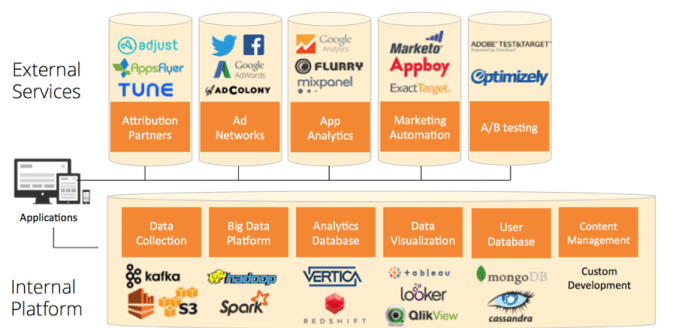
When it comes to getting the most value out of data, successful companies take a practical approach, first defining their own data strategy and then determining the tools needed to get it done. A good example of this is Airbnb, which set their own data strategy and tools to help users more accurately price their home listings. Too often, however, companies fail to lay out a clear strategy, instead relying on the available tools to show them where they need to go. Unfortunately, these tools usually serve up packaged metrics with data that is too detailed and lacks cohesion.

The mobile marketing data landscape
marketing data landscape mobile

In VentureBeat’s The State of Marketing Analytics: Insights in the age of the customer, author Jon Cifuentes writes:

“Enterprises are stuck between fragmented data silos…There’s customer data, inventory data, log data, search data, reporting, analytics, CRM, session data, et. al – with different vendors supporting each. While “real-time” customer data sounds nice in theory, the actual process of broadcasting this information through the organization is time-consuming, expensive, fragmented, and frustrating.”

These cobbled-together sources and tools provide directional insight but don’t align with initial expectations, particularly as companies start requiring custom insights and metrics.  In fact, most companies quickly find themselves in exactly the situation they had hoped to avoid – working in increasingly complex systems with considerably higher non-value added workloads.

data silo

The challenge for companies is: how do you align your data vision with your unique acquisition, engagement and monetization strategies?

Purpose-built tools like app analytics, A/B testing, marketing automation, etc. have done a great job in recent years of allowing non-technical people to analyze data, run tests and engage users. However, since these tools were built for single-use cases and by separate companies with proprietary data stores, they have failed to address a core issue: the need to access the same user data in order to truly provide a personalized experience to each user.

Data-capture tools and user engagement tools also need to be integrated in order to provide a full picture of how changes impact the product downstream.  For instance, teams need to be able to apply user actions from app analytics to run A/B tests, which will in turn impact the user experience.

The path forward

The solution exists at the platform level: unifying data sources before applications are built on top of them, with a flexible 2-way structure that enables real-time integration between event and user data, at all levels in the stack, and not just based on basic pre-determined rules with segmentations on top.

data silo2

This type of structure makes it possible for events to be enriched by boundless user attributes (user state) and enables contextual analytics.  This, in turn, produces a robust targeting framework, because now the user state can be updated in any manner, in real-time.  For example, Glassdoor utilizes this methodology to deliver real-time dynamic notifications of job alerts to users based on their prior behavior when browsing the Glassdoor website.

While many marketing vendors are fighting to define themselves as integrated or unified marketing platforms, most still need to reach deeper down the stack and unify product and marketing tools with data tools at a platform level.   Because they refer to the same data source, there will be no discrepancies between insights and actions.  For example, segments defined for analytics will maintain the same properties in A/B testing or content delivery.  Applications developed on top of unified data platforms will be inherently more flexible and manageable.

From VentureBeat

Omniata is coming out of beta on September 24th!  You can reach us at [email protected] to learn more. Though just coming out of beta, we’re already tracking 300 million monthly active users, 2 billion events per day, and handling over 17,000 requests per second!

Alex Arias is the CEO and cofounder of Omniata, a unified data, analytics and user engagement platform.  For more than 10 years, Alex has been an entrepreneur and driver of innovation in digital services, working previously at Digital Chocolate and EA.  He’s been helping companies define their own Data Value Journey since cofounding Omniata two and a half years ago.


RSS-5

Posted on

5 tips for running your first influencer marketing campaign

Thurs

Feed-twFeed-fb

This article is part of SWOT Team, a series on Mashable that features insights from leaders in marketing, brand-building and public relations.

The rise of social media has given consumers more power than ever before, arming them with a platform where they can engage brands in real time. This has created a shift in marketing. While traditional tactics involved pushing out brand content with little focus on creating conversations, new campaigns tap influencers to engage with consumers and create brand loyalty among them.

In spite of the positives, the rise of influencer marketing has also led to many questions, like how to select the right influencer agency or measure ROI. Here are the five most important things to know before you begin your first influencer campaign Read more…

More about Influencers, Branded Content, Business, Marketing, and How To


RSS-3